

Amazon is rewriting your titles on July 27. Here's what you need to know first.
I studied 74 winning Amazon titles. Eight patterns showed up in every one. (Amazon just made them more important.)

A client sent me their omega-3 supplement title and asked why it wasn’t converting.
The title was fine. Clean. Professional. It covered the category keyword, the dosage, the format. There was nothing wrong with it by any conventional measure.
I pulled the competitor reviews anyway. Not their reviews, their competitors’ reviews. And the same phrase kept showing up, over and over, across every brand in the category. Five-star reviews, one-star reviews, didn’t matter:
“Finally, one that doesn’t have that fishy aftertaste.”
I looked back at the title. No mention of fishy aftertaste. No mention of aftertaste at all. The brand had been treating that as detail-page information, not title-level information.
We added three words: “No Fishy Aftertaste.”
Orders went up 439%. I’ve been quoting that result in client briefs ever since, and it still surprises me every time I say it out loud. Three words pulled from a competitor’s one-star reviews.
That’s the kind of thing this playbook is built around. And it’s why the Amazon change coming on July 27 matters more than most people realize.
What Amazon is actually doing, and why it’s not the disaster some people think
If you sell on Amazon, you may have gotten a notice a few weeks ago. Here’s what it said, verbatim:
“Starting July 27, 2026, titles in all categories except for media will need to be 75 characters or less including spaces.”
What that means: If your title is longer than 75 characters (and if it was professionally optimized in the last five years, it almost certainly is), Amazon will rewrite it for you after the deadline.
What to watch: Their AI generates the replacement. You get 14 days to review and approve it in Seller Central before it goes live.
I’d strongly recommend not leaving that to Amazon’s AI.
Here’s the part that doesn’t get talked about as much, though: this isn’t actually a penalty. Over 70% of Amazon shoppers browse on mobile.
Titles have always truncated at roughly 70–80 characters on mobile, regardless of how long they actually were. The back half of your 190-character title has been invisible to most of your shoppers for years. Amazon is just formalizing what mobile was already doing.
What’s new is what they’re adding alongside the shorter title.
Amazon is rolling out something called Item Highlights, a 125-character field that sits below the title in search results and on product pages.
Their description: “materials or recommended use cases that help customers compare options.”
The good news: It’s searchable. It’s indexed. It’s visible.
So here’s the part that made me feel better when I dug into it: the total keyword real estate doesn’t shrink. It reorganizes into two fields with two different jobs:
75 characters to earn the click from search.
125 characters to win the comparison once the shopper lands.
That’s actually a cleaner architecture than what existed before, if you know how to write for both fields.
What we built before we knew this was coming
We optimize titles for roughly 150 Amazon brands a year and that amounts to thousands of titles.
Across our Amazon Experiments:
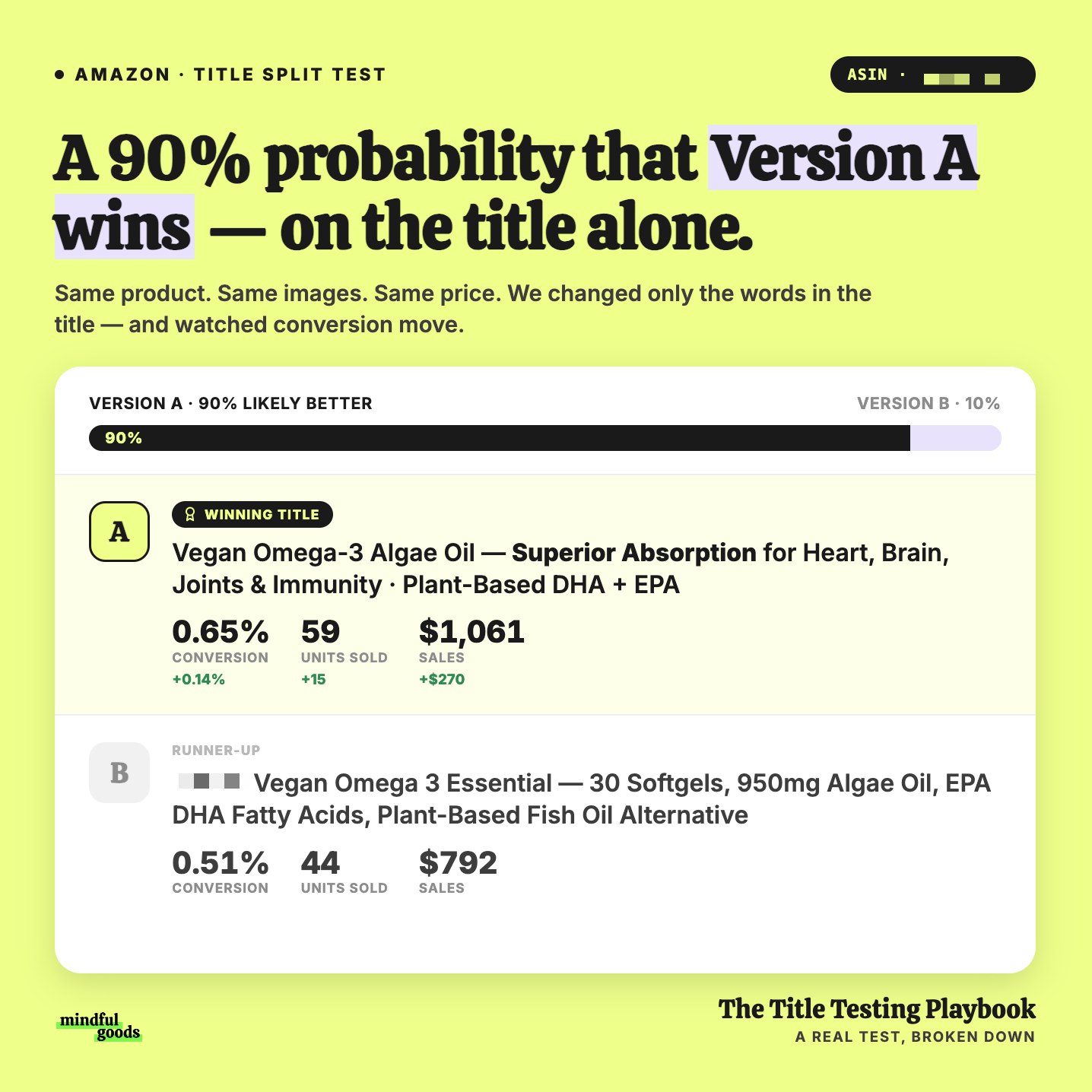
75.9% of our title tests show a measurable uplift in sales.
Median orders lift: +30%.
Peak: +990% in orders on a single listing.
Before the July 27 announcement, I’d been trying to figure out what the winning titles had in common. So I pulled 74 of them (a random selection, not cherry-picked) and went looking for patterns.
Supplements, snacks, skincare, oral care, frozen food, pet food, kids crafts, sleepwear. Fourteen categories. Seventy-four titles.
Eight patterns showed up in every winning title on file.
When I looked at those patterns through the lens of the July 27 change, something became clear: the patterns don’t disappear at 75 characters.
They redistribute. Some belong in the title. Some move to Item Highlights. But every single one of them still applies, and in some cases they matter more now because there’s less room to recover from getting them wrong.
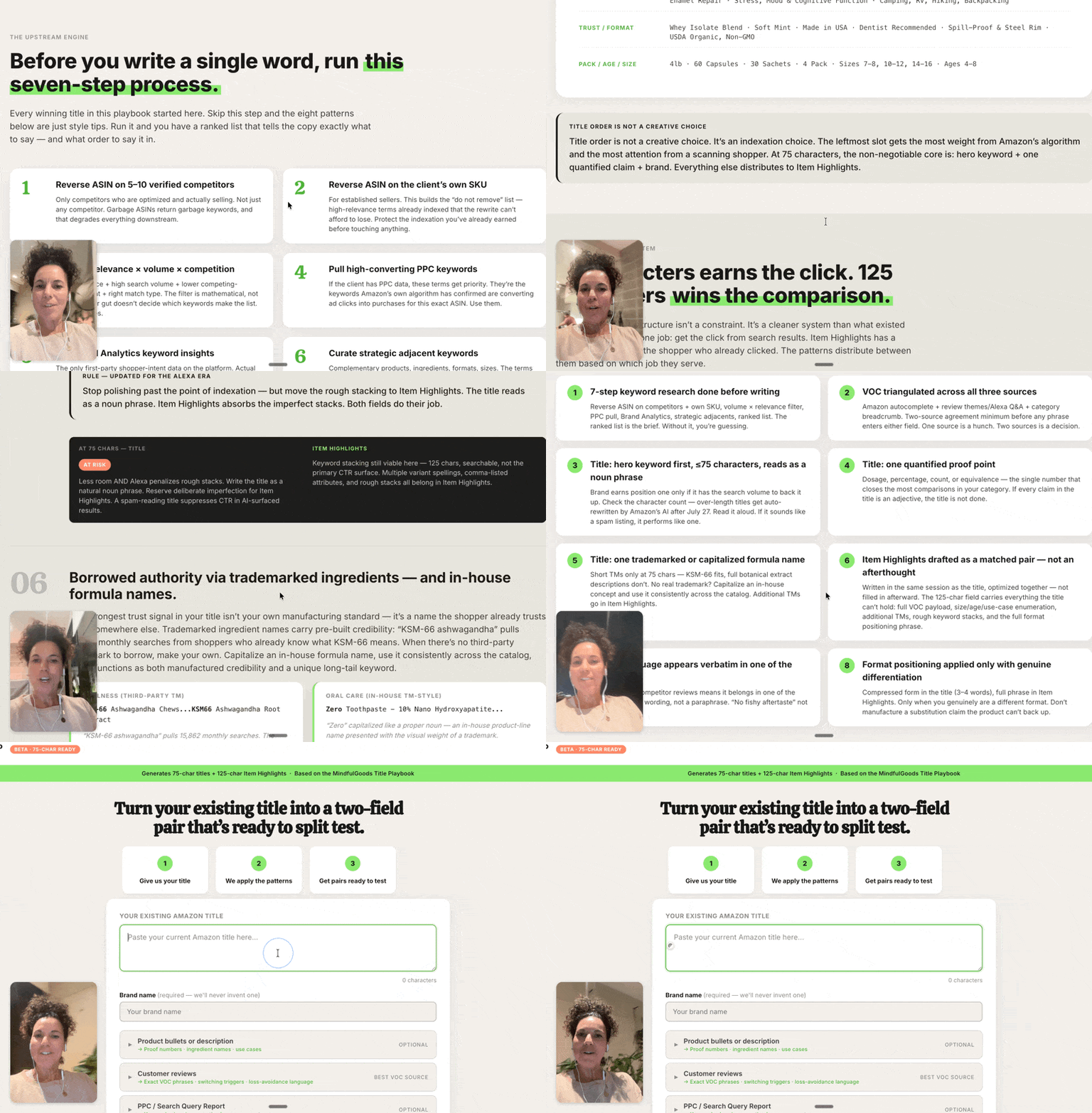
I turned this into a playbook. All eight patterns, documented with the verbatim title examples, the lift numbers, the shopper psychology behind each one, and exactly how they map to the new two-field system.
Paid subscribers get a preview of three of those patterns below.
The full playbook (all eight patterns, plus the 7-step keyword process and the title generator tool we built around it) is on Stan Store.
Full playbook + tool access on Stan Store → [Stan Store link]
The deadline is July 27. If you want your titles rewritten on your terms (using patterns drawn from 74 tested winners), that’s the window.
🔒 Now Let’s Get To The Good Stuff
Upgrading to paid is like getting the version of my brain that isn’t filtered for a general audience. Less than one Starbucks order per week, and you get the strategy I charge clients real money for — broken down so you can use it yourself.
Below the paywall:
The most reliable thing we found
The thing that surprised me most
The one that feels obvious but almost nobody does correctly
