
Every supplement brand on Amazon is fighting over the same badge. We tested it 140 times. The badge almost never wins the sale.
Certifications show up in supplement testing 2.2x more than any other category. And the tests where they dominate are the ones most likely to end in a tie.

Last month, I went full nerd and did something I’d been wanting to do for years. I used Claude to analyze 900+ PickFu split testing polls (now 991) from 34,000 respondents across the 850+ eCommerce brands we’ve worked with. The result was a database that lets me look up trends, spot patterns, and answer almost any question about a client’s creative before we even start designing. This has reframed how my team and I make every creative decision and I’m sharing all of it here in Design Proof. Twice a week: data-backed creative insights to help you convert better on Amazon and eCommerce.
Certifications are the most talked-about thing in supplement creative. Across 140 supplement split tests we’ve run on Amazon (4,600+ real Prime shoppers, 58+ brands), shoppers brought up clinical proof, third-party testing, or certification badges in 36% of polls. That’s 2.2x the rate of every other category we test.
So you’d assume the badge is the thing that wins the sale. Put the certification front and center, win the click.
The data says the opposite.
When certification talk dominates a supplement test, the result is basically a coin flip. Only 44% of those polls produced a decisive winner (17 of 39). That’s the worst decisiveness rate of any category we track. For comparison, grocery polls are decisive 90% of the time. When everyone’s arguing about badges, nobody wins.
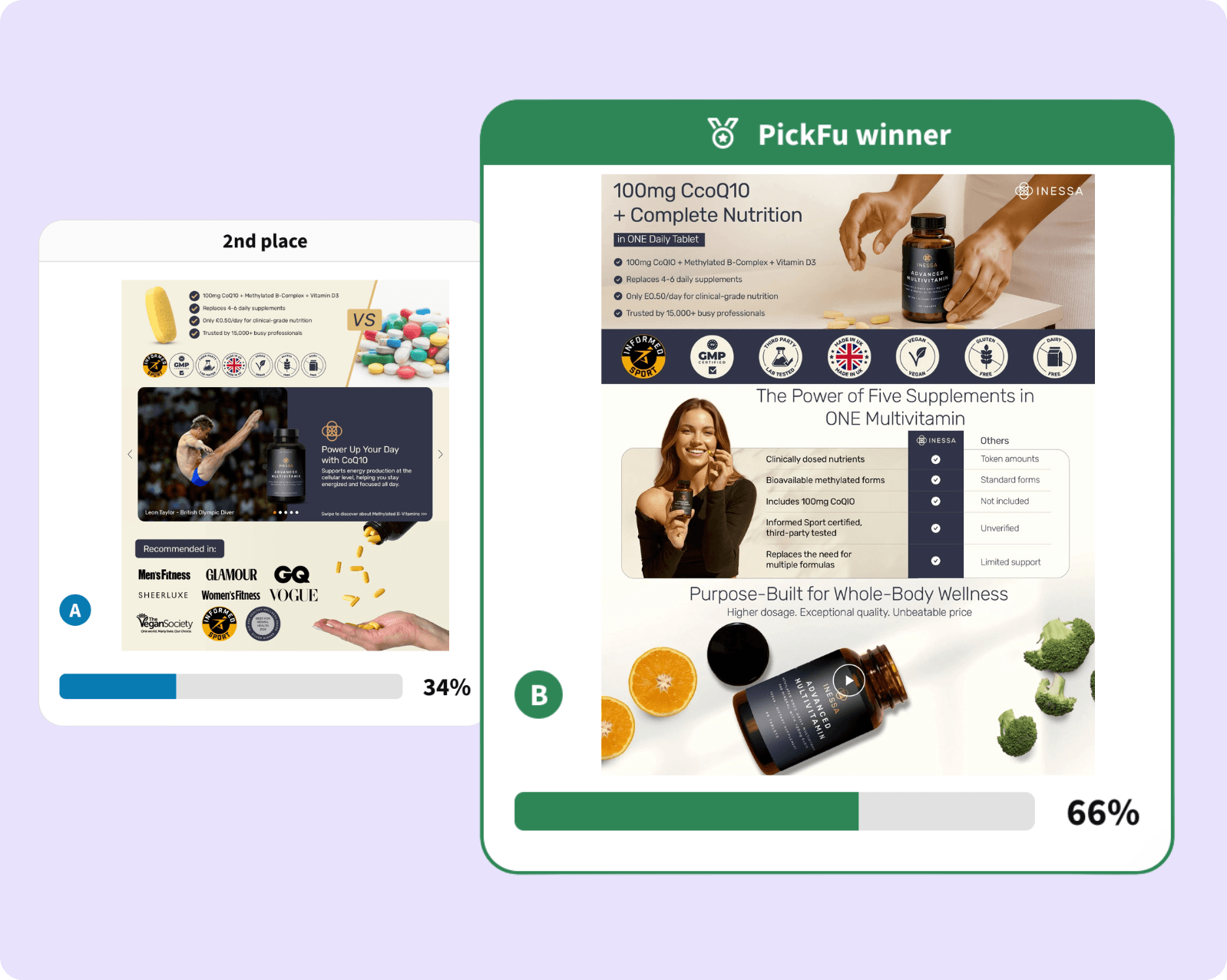
Here’s the part that flips it. When the winning image itself carries a certification badge, it wins decisively 79% of the time (27 of 34).
Read those two numbers together, because that’s the whole insight:
Tests about certifications: 44% decisive (a wash).
Winners that have a badge: 79% decisive.
The badge isn’t what wins. It’s the expectation. Miss it and you lose customers. Have it, and you’re exactly like everyone else who has it.
Real shoppers say it plainly:
“This ad layout looks the most professional with clinical information that would be ideal to talk to a doctor or pharmacist about efficacy.” (Female, 55-64)
“Option C, the USDA organic label can clearly be seen. Peace of mind knowing product does not contain harsh chemicals.” (Male, 35-44)
Notice what they’re describing: relief that the badge is present. Not excitement, not a reason to choose you over the other bottle that also has one.
In grocery, a certification differentiates you. In supplements, it’s the entry fee.
And if every pays the same entrance fee, it all becomes a wash.
If Amazon creative talk is your jam, be sure to check out our Top 10 Supplements roundup, that dropped on YouTube today.
Here’s where I think most brands leave money on the table. They earn the certification, they place the badge, and then they stop. As if the icon does the talking.
It doesn’t.
The average shopper does not know what most of these certifications actually mean. They don’t know the testing standards behind them, they don’t know which ones are hard to earn versus easy to slap on, and they definitely don’t know that your process might be more rigorous than the brand sitting right next to you on the shelf. They glance at the badge and feel a small, vague sense of “okay, this seems legit.” That’s it. That’s all a badge on its own buys you.
Think of it like a diploma hanging on a wall. It tells someone you’re qualified, but it doesn’t tell them what you actually learned or why you’re better at the job than the person next to you. The badge is the diploma. The story behind it is what actually earns trust.
So if you hold yourself to a higher standard, say it. If you test for things other brands skip, say that too. If your certification is one that very few brands in your category have managed to earn, that is not a detail to bury. This is exactly the stuff people care about when they’re putting something into their body. They want to feel safe, and safety is a feeling you create with specifics, not symbols.
In our experience, badge-versus-badge tests end in ties, and brands keep spending their most valuable creative real estate on the one element that no longer moves anyone.
Which raises the real question. If the badge is table stakes, what actually wins the supplement shopper?
We know, because we measured it. There are three levers that separate the decisive winners from the coin-flips, and none of them is the thing most brands are optimizing.
🔒 Now Let’s Get To The Good Stuff
Upgrading to paid is like getting the version of my brain that isn’t filtered for a general audience. Less than one Starbucks order per month, and you get the strategy I charge clients real money for — broken down so you can use it yourself.
Below the paywall:
The three creative levers that actually decide supplement tests (with the exact sample sizes behind each)
Why “clean and minimal” is backwards in this category
More unblurred winning images
The supplement main image decision matrix
Bonus: Claude prompt to score your own main image against the pattern
Subscribe to unlock.
