

Prime Day Just Started. Here's What Your Listings Are Telling You.
The data you collect in the next 48 hours is your Q4 roadmap.

Prime Day started this morning.
If you’re watching your sales dashboard and feeling good about it, that’s understandable. Deal is performing, sessions are up, revenue is tracking. That’s the right thing to want on a Prime Day.
But there’s a different number you should pull right now.
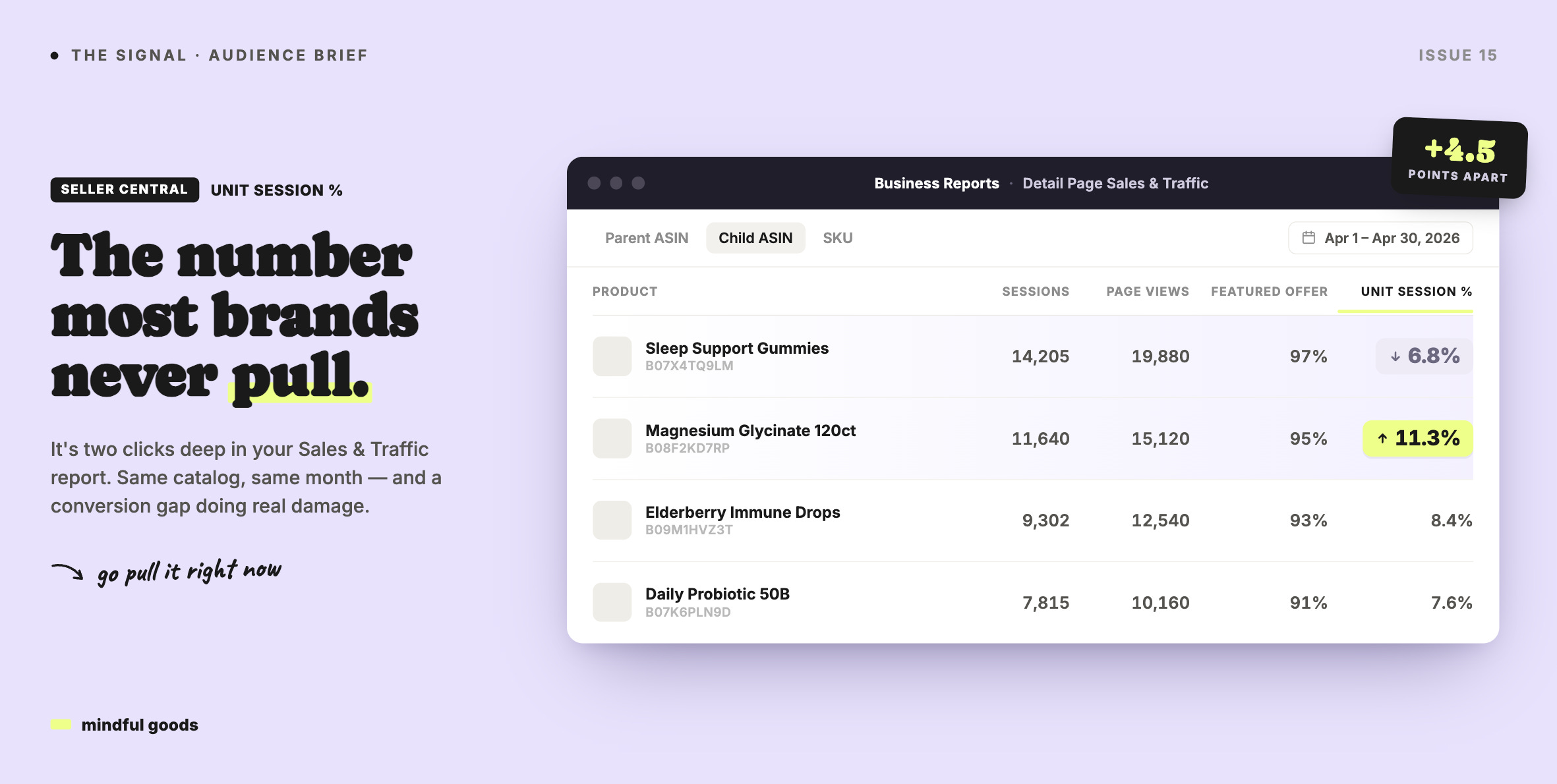
Unit session percentage. That’s what Seller Central calls your conversion rate: the ratio of shoppers who visited each listing to shoppers who bought.
Pull it for today’s window, even if Prime Day just started a few hours ago. You’re not looking for a final number. You’re watching direction.
Here’s what makes Prime Day so useful beyond the revenue: the traffic is cold.
Shoppers on Prime Day are browsing broadly, comparing quickly, and less committed before they land on your listing. They found you through a deal, not through search intent. That’s a fundamentally different shopper than the one who finds you organically on a Tuesday in March.
And that cold traffic pattern? That’s what Q4 sends you at scale.
Black Friday, Cyber Monday, the full holiday window: that traffic runs colder than your typical organic search baseline. Deal-driven, comparison-shopping, brief attention. When your Prime Day conversion rate holds up against cold traffic, that’s signal. When it doesn’t, that’s also signal, and it’s the more useful one.
I have some version of the same conversation every July. A brand doing real volume on Amazon, feeling good about their Prime Day revenue, and then we pull up the conversion rate together and there’s a pause. A number like 6.8% on a brand doing around $4M when their Q4 rate last year was 11.3%.
Same products. Same listings. The deal drove traffic their listings couldn’t convert at the rate their warmer organic traffic does. That gap is where the gold is. And right now, with Q4 about 12 weeks out, there’s still time to do something about it.
By October, there won’t be.
Designing and split testing content on PickFu needs time for iteration. Making creative changes on Amazon takes time to settle. Amazon Experiments, the platform’s built-in testing tool, takes 4-8 weeks to reach meaningful data. New images and SEO copy need time for the algorithm to index them and for session data to accumulate.
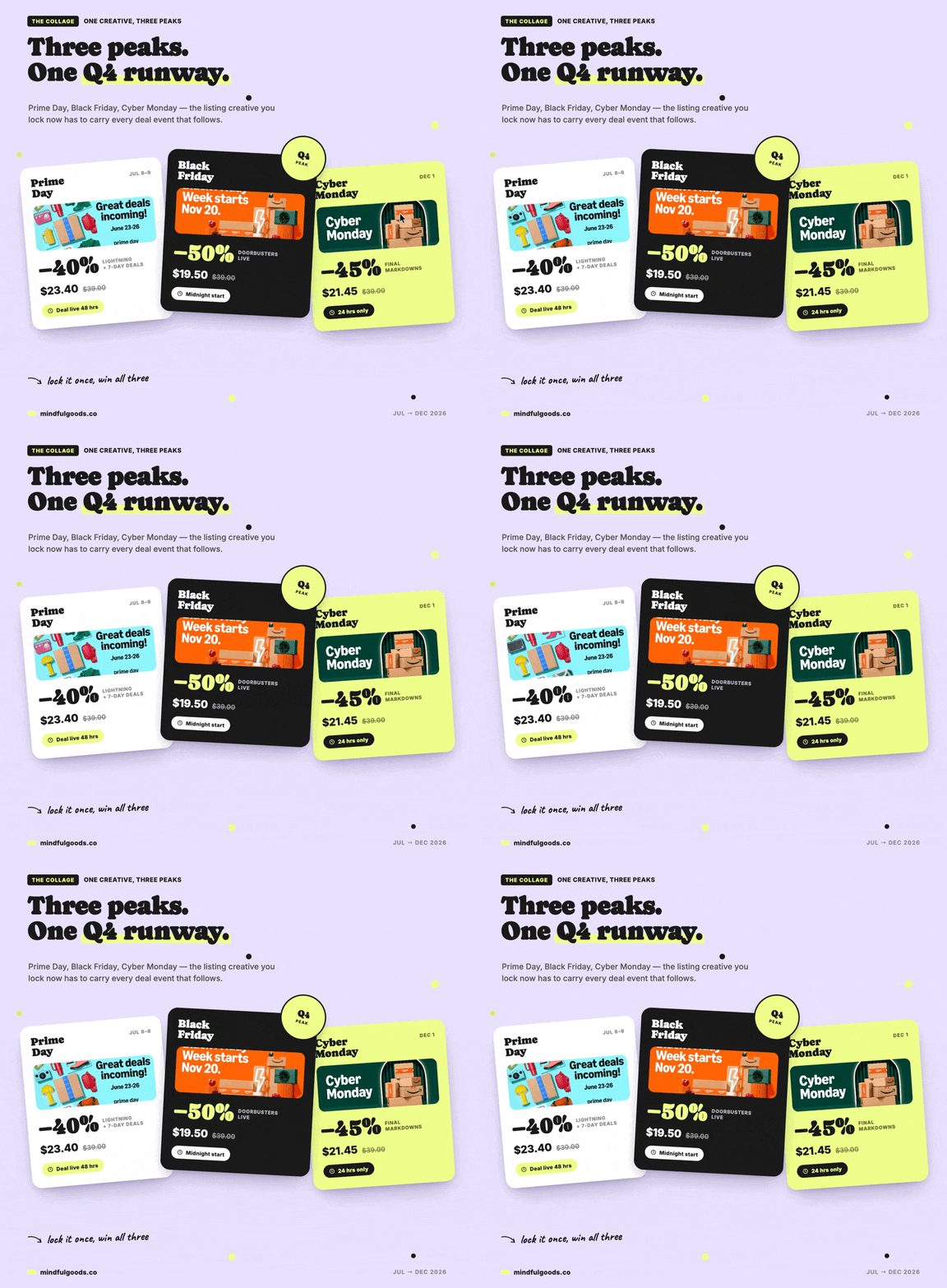
If you’re swapping creative in November, you’re running untested content during the highest-stakes traffic window of the year, and you won’t know if it’s working until December.
The brands that enter Q4 with confidence used the summer to do the work. Prime Day either confirmed their listings were ready, or it showed them exactly what to fix while there was still time to fix it.
This is go-time. Let’s do this.
The full game plan is in the paid section below.
🔒 Now Let’s Get To The Good Stuff
Upgrading to paid is like getting the version of my brain that isn’t filtered for a general audience. Less than one Starbucks order per month, and you get the strategy I charge clients real money for — broken down so you can use it yourself.
Below the paywall:
What your Prime Dat data is actually telling you
The Q4 content sprint game plan
How to scale the execution
BONUS: Post-Prime Day Optimization Playbook with our top recommended split tests to run before Q4 (free for paid members)
